Hours: Mon & Thu 9:30–7 · Tue & Fri 8:30–6 · Wed/Sat/Sun Closed
(908) 771-0220
Tendon Care
A clinical comparison for patients weighing their options — what the evidence shows about long-term outcomes, risks, and who benefits from each approach.
When a patient presents with plantar fasciitis, Achilles tendinopathy, or a chronic rotator cuff problem, two treatment options come up repeatedly in the conversation: cortisone injections and shockwave therapy. Both are legitimate interventions. They work through entirely different mechanisms, carry different risk profiles, and produce different long-term outcomes. Understanding the distinction helps patients make an informed decision rather than defaulting to whichever option their primary care physician mentions first.
Cortisone (corticosteroid) injections reduce inflammation at the injection site. For acute tendon irritation with significant inflammatory activity, a well-placed injection can produce rapid, meaningful pain relief — often within 48 to 72 hours. That speed is why they remain widely prescribed.
The problem is that most chronic tendinopathies are not primarily inflammatory conditions. Research over the past two decades has established that chronically degenerated tendons — the plantar fascia that has been painful for six months, the Achilles that has been thickened and nodular for a year — show tendinosis, not tendinitis. The histology is degenerative: disorganized collagen, neovascularization, mucoid degeneration. Inflammation is minimal or absent.
When cortisone is injected into a tendinotic tendon, it reduces the limited inflammatory activity that remains — but it does nothing to address the underlying disorganized collagen matrix that is causing the pain. The relief is real, but it does not reflect tissue repair. Repeated cortisone injections can actually weaken tendon structure, and there is robust evidence that multiple injections increase the risk of tendon rupture in weight-bearing tendons like the Achilles and patellar tendon.
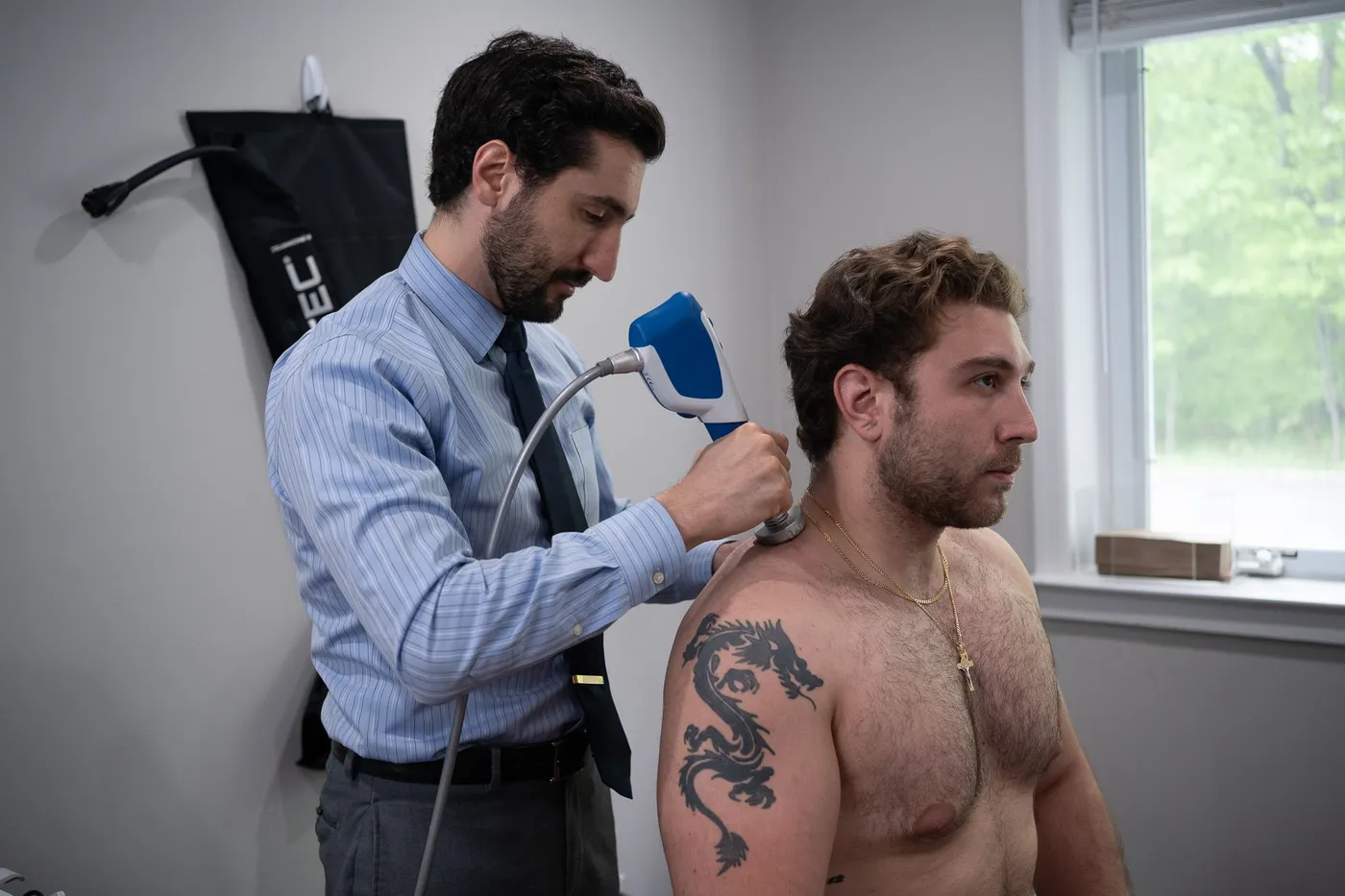
Extracorporeal shockwave therapy (ESWT) does not reduce inflammation. Instead, it delivers focused acoustic energy to the pathological tissue and produces a controlled mechanical stimulus that initiates a cascade of biological repair: increased local blood flow, stimulation of tenocytes to produce new collagen, breakdown of calcific deposits, and disruption of pain-mediating nerve fibers.
The result is actual tissue remodeling. The disorganized collagen in a tendinotic tendon is partially replaced by organized, functional collagen. This is why shockwave's effects tend to be durable — the tissue itself improves, not just the pain signal from it.
The tradeoff is time. Patients typically complete 3 to 5 sessions over 3 to 5 weeks, and maximum benefit often appears 6 to 8 weeks after the treatment series concludes as collagen remodeling continues. Patients who require rapid return to activity may find this timeline challenging — which is a legitimate clinical consideration, not a failure of the treatment.
For plantar fasciitis, randomized controlled trials consistently show shockwave therapy produces superior long-term outcomes compared to cortisone injection when assessed at 12 and 24 months. Cortisone produces greater short-term pain relief (weeks 4 to 8), but shockwave patients sustain improvement while cortisone patients tend to relapse.
For calcific shoulder tendinitis, shockwave has an unusually strong evidence base — it is one of the few non-surgical interventions that demonstrably reduces or eliminates calcium deposits in the rotator cuff, which is something cortisone cannot accomplish.
For Achilles tendinopathy, shockwave is generally preferred over cortisone — particularly at the insertion, where repeated corticosteroid injection carries the highest rupture risk.
This is not a binary choice in every case. Some patients receive a single cortisone injection to reduce acute pain enough to participate in shockwave and loading therapy. The combination is clinically reasonable when the inflammatory component is significant and the patient needs near-term functional improvement to continue working or competing.
The decision depends on the specific diagnosis, duration of symptoms, your history with prior injections, functional demands, and risk tolerance. At DeFabio Chiropractic, we examine the pathology before making a recommendation — not every patient with heel pain is a shockwave candidate, and not every patient with shoulder pain benefits from cortisone first.
What we consistently recommend against is repeated cortisone injection without a plan to address the underlying tendon pathology. Three or four injections spread over a year in the same tendon is not a treatment strategy — it is deferral of a problem that requires active intervention.
Schedule an evaluation at DeFabio Chiropractic in Berkeley Heights, NJ to find out if shockwave therapy is appropriate for your condition.